IEA report highlights innovation ecosystem on novel geothermal drilling technologies
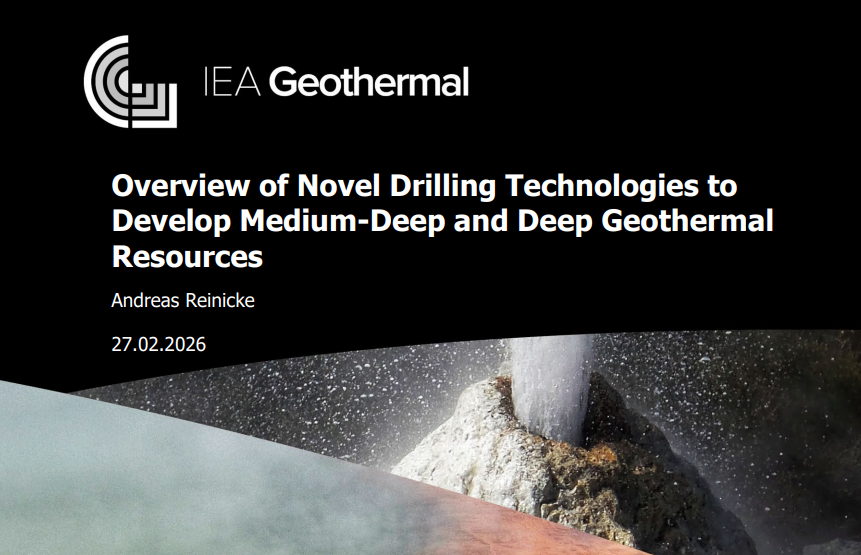 "Overview of Novel Drilling Technologies to Develop Medium-Deep and Deep Geothermal Resources" by IEA Geothermal


 Carlo Cariaga
7 Apr 2026
Carlo Cariaga
7 Apr 2026
A new IEA report presents an overview of the extensive portfolio of novel geothermal drilling technologies currently under development.
A new report from IEA Geothermal offers an overview of ongoing efforts to develop novel geothermal drilling technologies that aim to make medium-deep and deep geothermal resources more accessible. The report is timely as well, as the geothermal sector sits at a point of growing pressure to cut drilling costs, reduce risk, and expand beyond its traditional resource base.
Published under IEA Geothermal’s Working Group 13 on Emerging Geothermal Technologies, the 2026 report, “Overview of Novel Drilling Technologies to Develop Medium-Deep and Deep Geothermal Resources,” was prepared by Andreas Reinicke. The report sits within a broader IEA Geothermal effort on drilling technology and is closely linked to a 2025 update presented at GeoTHERM in Germany and a paper presented at the European Geothermal Congress 2025 in Switzerland.
Drilling has been recognized for a long time as one of the primary cost drivers for geothermal development. According to a 2025 report published by NREL (now the National Laboratory of the Rockies), drilling accounts for 30% to 57% of the total costs of a geothermal projects. The IEA report echoes this sentiment, making a point that new drilling and well construction approaches are necessary to make next-generation geothermal scalable and globally deployable.
While a list of technology companies and research consortiums cited in the report would be too long, it mentions several players that ThinkGeoEnergy has covered extensively through the years, including GA Drilling, Canopus Drilling Solutions, Hephae Energy Technology, HydroVolve, Quaise Energy, the DeepU project, Borobotics, and GeoDrill among many others.
Several pathways to cheaper, more effective drilling
The report frames “novel drilling technologies” as an extensive portfolio comprising of different approaches with their own respective goals. The list includes mechanical drilling, hybrid drilling systems, and non-mechanical or direct-energy concepts, each trying to solve a different bottleneck in hard rock, high temperature, or directional well construction. Only technologies that demonstrate an estimated Technology Readiness Level (TRL) of at least 5 are presented in the review.
The breadth of the work being done in this space is very briefly summarized in the diagram below:
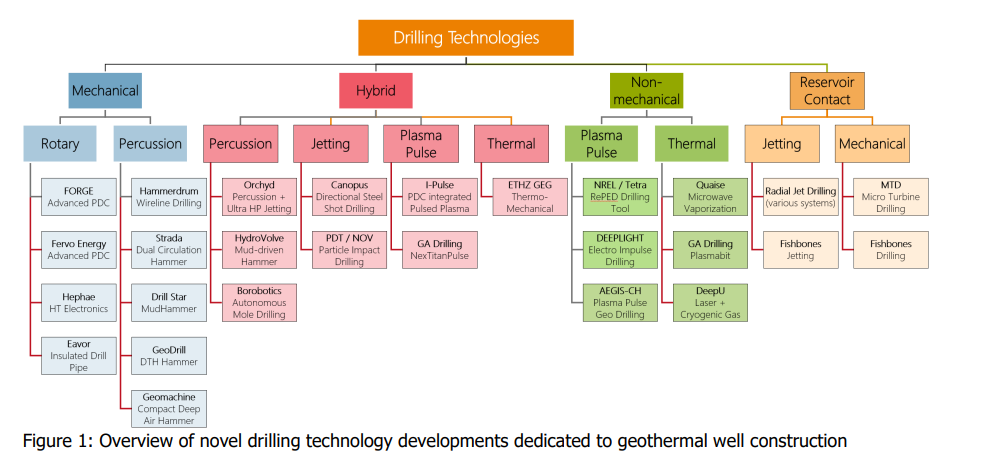
The first group covers advanced mechanical drilling methods. These remain rooted in conventional rock-breaking, but seek better performance through changes in bit design, downhole tools, or drilling mechanics. In practice, this is the most direct route for improving existing geothermal drilling workflows because it builds on methods already familiar to drilling teams.
A second group in the report’s broader technology landscape is hybrid drilling. These systems combine two or more drilling mechanisms in order to overcome the limits of standard rotary drilling in hard formations. Representative examples include the combination of high-pressure water jetting with percussion drilling, or plasme pulse drilling combined with traditional mechanical methods. These methods add a second rock-breaking mechanism to bridge the gap presented by crystalline formations or very high-temperature environments.
The third group covers non-mechanical drilling, sometimes described more broadly as direct-energy drilling. These technologies seek to break, weaken, or remove rock using energy input rather than relying mainly on physical contact between bit and formation. This group comprises some of the more radical geothermal drilling concepts that may present long-term potential for drilling in deeper and harder formations.
A fourth group represents drilling-based methods that have the potential to improve well productivity in geothermal projects, either through jetting or mechanical approaches.
A portfolio approach to address a wide set of challenges
The portfolio approach to novel geothermal drilling is an important signal for the wider industry, as it reflects the reality that drilling challenges can vary widely across different geologies, target depths, temperatures and pressures, and project objectives. More succinctly, this means that the future of geothermal drilling is not likely to depend on any single breakthrough.
Advanced mechanical systems, hybrid systems, and non-mechanical methods each appear suited to different parts of the problem. Some are aimed at improving drilling performance in hard rock. Others focus on enabling more complex well geometries or improving reservoir access. Some are trying to overcome the limits of conventional bit-based drilling altogether. Thus, the field can be better described as a broad innovation landscape rather than a technology contest.
With drilling accounting for some of the biggest costs in geothermal development, exploring multiple technical pathways appears to be a practical way forward for the industry. While some approaches may deliver incremental gains or improve tool life, others may help improve well productivity. On a more sobering note, some approaches may take a very long time to mature and some might not even get deployed on a commercial scale at all.
Taken together, the improvements provided by a diverse toolbox of drilling tools and technologies can combine to create a step-change in drilling cost optimization and better economics for geothermal projects.
Source: IEA Geothermal