Quaise presents development plans for 50-MW superhot geothermal plant in Oregon
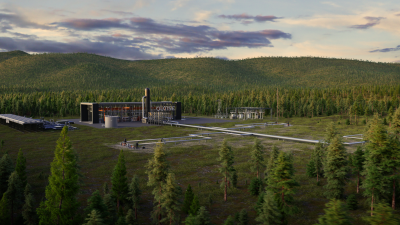
 Artist’s rendering of the Project Obsidian power plant being developed by Quaise Energy in Oregon. (source: Quaise Energy)


 Carlo Cariaga
24 Apr 2026
Carlo Cariaga
24 Apr 2026
Quaise has started preparatory work for a 50-MW geothermal power plant south of the Newberry volcano in Oregon, targeting a superhot enhanced geothermal system.
Pioneering geothermal technology and project developer Quaise Energy (Quaise) has presented more detailed development plans for Project Obsidian, a geothermal power plant that aims to tap into superhot geothermal resources in Oregon.
Phase I of the project envisions as 50-MW development which is expected to be operational as early as 2030, and a second phase targets 250 MW. The company had recently announced that it is seeking to raise USD 200 million in financing and grants to support the project. Quaise is also supporting research being done at the Oregon State University, which aims to recreate extreme subsurface conditions in the lab.
Well and reservoir design
Details on the development strategy for Project Obsidian were presented Senior Mechanical Engineer Daniel W. Dichter during the 2026 Stanford Geothermal Workshop. The paper from that presentation can be accessed here: Dichter, et al. (2026) Concept of a High-Temperature EGS Plant in Oregon.
The project site is located outside of and adjacent to the southern boundary of the Newberry National Volcanic Monument. Quaise had acquired exploration rights for 1334 acres in the region following a geothermal lease sale.
The development is expected to benefit from the exceptionally high geothermal gradients (about 100 °C / km) based on nearby well temperature logs. There are also two geophysical anomalies within the lease area – a low seismic velocity anomaly at 2300 meters depth, and a low-density anomaly across the southern rim. The Newberry Volcano, it must be noted, benefits from decades of detailed geothermal drilling and subsurface investigations and is also the site of the superhot Enhanced Geothermal System (EGS) project of Mazama Energy.
Quaise plans to develop two fractured reservoirs, one at 315 °C and another at 365 °C. For each reservoir, a triplet will be drilled, consisting of one injector and two producers. The development plan follows the company’s three-tiered blueprint for developing superhot and superdeep geothermal reservoirs based on how close the resource is to the surface. In this case, the 315 °C reservoir will bear the lower technical risk and provide learnings that will enable the drilling of the higher-temperature well.
Dichter notes that the first wells at Project Obsidian will be drilled conventionally, without millimeter wave energy. Conventional drilling technologies will remove rock near the surface (what they were optimized for), followed by millimeter waves for powering through the basement rock below. Millimeter waves won’t be used “until the 365°C wells at the earliest,” Dichter says.
The plant is expected to be comprised of two co-located units, one dedicated to the 315 °C reservoir and another for the 365 °C reservoir. The selection of power plant technology is informed by a study on power plant design for superhot geothermal sources, which had also been previously presented by Dichter. It is expected that the two planned triplets will have sufficient potential to produce the target 50 MWe capacity.
Current status and drilling plans
As of January 2026, work on access roads and drilling pad are nearly complete. Other ongoing activities include timber processing, rock crushing, and sump excavation. A 450 ft x 400 ft will host seven wells and a gathering system.
By Q2 2026, the aim is to start drilling a deep confirmation well. This will provide data that will be used to design, drill, and develop the future EGS wells. After open-hole logging, this well will be completed as a monitoring and fracture test well with fiber-optic cables and stimulation sleeves. The first pair of EGS wells will be drilled and stimulated in Q3 and Q4 2026, with the goal of performing a circulation test by the end of the year.
Processing of magnetotelluric data, collected in 2025, is also ongoing to characterize the subsurface and identify large local structures. Quaise is refining reservoir models to develop reservoir stimulation plans, while doing laboratory testing of proppants and zonal isolation equipment suitable for the extreme conditions expected of the planned wells.
Source: Quaise