Dominica geothermal plant nears commissioning after 15 years
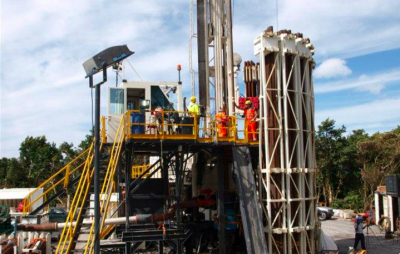
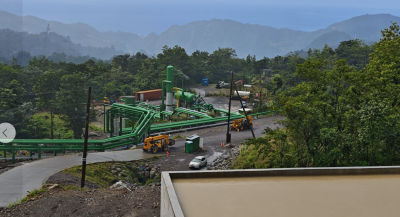
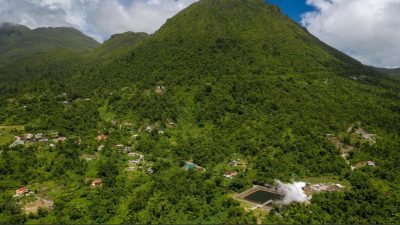
 Dominica geothermal plant under construction (source: facebook/ Vinir Dóminíku)


 Alexander Richter
21 Jan 2026
Alexander Richter
21 Jan 2026
Dominica’s 10 MW geothermal power plant is expected to enter operation in March, marking the culmination of more than 15 years of exploration, drilling, and institutional development.
After more than a decade and a half of exploration, drilling campaigns, regulatory work, and recovery from natural disasters, Dominica’s geothermal power project is expected to enter operation in early March, bringing the Caribbean nation’s first geothermal power plant close to commercial service.
A long geothermal development timeline
The Dominica geothermal project has been followed closely by ThinkGeoEnergy for many years, from early exploration work through drilling updates and financing milestones. Previous coverage has tracked the project’s progress and challenges, including expectations around a targeted start-up in early 2026, reflecting the often lengthy and non-linear nature of geothermal development in small island systems.
Initial geothermal exploration in the Roseau Valley dates back to around 2010, when Icelandic consultancy ÍSOR began advising the Government of Dominica on the country’s geothermal potential. At that time, international financing from the French Development Agency and the European Union enabled the drilling of three exploratory wells. Here some local coverage from that time.
Drilled between 2011 and 2012 to depths of roughly 1,300 to 1,650 metres, the wells encountered a high-temperature geothermal system with reservoir temperatures estimated at around 250-270°C. While the wells showed varying productivity, each produced measurable steam flows, confirming the presence of an open and productive geothermal resource beneath the Roseau Valley.
Resource confirmation and stepwise expansion
Building on these results, additional funding was secured to drill two further wells in 2013-2014, one intended as a production well and the other for reinjection. The production well proved particularly successful, delivering steam flows in the range of 12-15 kilograms per second, sufficient to support an estimated 5-8 MW of power generation capacity from a single well.
The reinjection well, however, did not perform as planned, underscoring both the technical risks involved and the iterative learning process that characterises geothermal development. Despite this setback, the drilling campaigns collectively demonstrated that Dominica hosts a high-quality hydrothermal resource capable of supporting commercial power generation.
Institutional development and external shocks
In the years that followed, progress slowed as attention shifted toward strengthening the regulatory and legal framework for geothermal resource development. In 2016, the Dominican government established the Dominican Geothermal Development Company Ltd. (DGDC) to manage and develop the country’s geothermal assets.
Momentum was severely disrupted in 2017 when Hurricane Maria struck the island, causing widespread damage to infrastructure and delaying energy sector investments. In the aftermath, the World Bank played a central role in Dominica’s recovery, supporting grid rehabilitation and providing funding for additional geothermal drilling aimed at improving energy security and resilience.
Under this renewed effort, ÍSOR returned to support further geothermal work, including reservoir modelling and the siting of two additional wells. Engineering design and drilling site preparation were carried out in cooperation with Mannvit, now part of COWI. The drilling programme, completed in 2023, delivered two strong wells, each designed for its respective role in production and reinjection.
Power plant development and grid integration
With the geothermal resource further de-risked, DGDC entered into an agreement with Ormat Technologies Inc. for the financing and construction of a 10 MW geothermal power plant near the wellfield. A local subsidiary, the Geothermal Power Company of Dominica, was established to own and operate the facility during the term of the resource agreement.
Under the current structure, ownership of the plant is expected to be transferred to the Government of Dominica once the 25-year resource concession expires. In parallel with power plant construction, Dominica’s electricity transmission and distribution network has undergone substantial upgrades, largely supported by World Bank financing, to enable the integration of geothermal power into the island’s grid.
Commissioning support and operational readiness
As commissioning approaches, DGDC has engaged ÍSOR once more to provide technical support during start-up, with a particular focus on reservoir monitoring, production data management, and system response during early operations. Icelandic company HD ehf., specialising in geothermal power plant operation and maintenance, has joined this effort, contributing expertise in plant commissioning and operational readiness.
A recent detailed overview of the project’s history and technical development was shared publicly via a Facebook post by individuals closely involved in the work, highlighting the long-term commitment required to bring the project from early jungle-based fieldwork to near-commercial operation.
A milestone shaped by persistence
If commissioning proceeds as planned, the Dominica geothermal plant will mark a significant milestone not only for the island’s energy system but also for geothermal development in the Caribbean region. The project illustrates the long timelines, institutional coordination, and resilience needed to deliver geothermal power, particularly in small and climate-vulnerable island states.
For ThinkGeoEnergy, the project stands as an example of why sustained coverage and long-term perspective remain essential when reporting on geothermal development globally.
Sources: Vinir Dóminíku/ facebook, ThinkGeoEnergy reporting