Baker Hughes – Enabling Enhanced Geothermal Systems with transformative technologies
 Feature article - Baker Hughes: Enabling Enhanced Geothermal Systems with Transformative Technologies


 Carlo Cariaga
18 Aug 2025
Carlo Cariaga
18 Aug 2025
With growing interest in Enhanced Geothermal Systems, Baker Hughes is deploying both new and established technologies to help accelerate its deployment.
Enhanced Geothermal Systems (EGS) are emerging as one of the most promising frontiers in geothermal energy, potentially enhancing its productivity and efficiently, and making it possible to implement geothermal projects in more parts of the world.
To learn more about EGS and the technologies that are enabling its adoption, we spoke with Ajit Menon, Vice President for Geothermal at Baker Hughes, a global energy technology company with decades of geothermal experience and is actively involved in current EGS efforts. In this interview, Ajit provides fantastic insights into how the company is enabling the growth of EGS through transformative technologies, drawing from its rich history in both geothermal and oil and gas.
Why and how EGS can accelerate geothermal growth
Enhanced Geothermal Systems (EGS) seek to overcome the geographical limitations of conventional geothermal systems by engineering reservoirs in hot, impermeable rock, using stimulation techniques to create artificial flow paths. Baker Hughes considers EGS as a huge opportunity to scale geothermal and accelerate its growth, targeting sites that would not have been considered for conventional systems.
“In the U.S., for example, EGS allows us to move beyond traditional hotspots on the West Coast into much broader territories across the western U.S., where there is high heat but no existing reservoirs,” Menon noted. “This opens up significant new ground for geothermal deployment.”
With the location flexibility of EGS, it becomes an attractive prospect for any industry or use case that needs constant clean energy. This has drawn interest from organization such as the US Department of Defense, as well as data centers. It is also worth considering for islands or remote areas that need to import energy, or have limited land available for solar and wind.
An important technical benefit of EGS is its reduced development risk. EGS allows developers to start with a known geological setting and build the reservoir artificially, leveraging temperature gradients and rock type without entirely relying on the existence of complex hydrothermal reservoirs. This makes it a more attractive option for new investors and developers seeking more predictable outcomes.
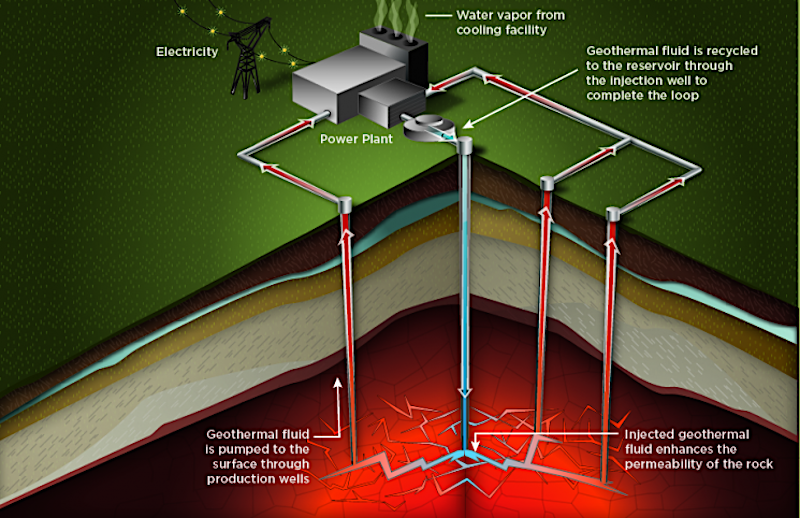
Baker Hughes has taken a technology-agnostic stance on geothermal development, building a broad portfolio that addresses the entire geothermal value chain: from subsurface imaging and drilling technologies to artificial lift and surface power generation equipment. According to Menon, EGS represents a major step change in the geothermal sector’s ability to scale, both geographically and in terms of project size.
Riding the wave of the shale revolution
EGS as a concept has been around for decades. Even in the 1970s, there have been early efforts for research in EGS, then-known as “hot dry rock.” However, the commercial viability of EGS is now being redefined by technologies and methodologies derived from the shale gas revolution. The oil and gas sector’s advancements in high-temperature drilling, horizontal wells, and large-scale stimulation are now being repurposed for geothermal applications.
Baker Hughes draws extensively from its experience in unconventional oil and gas, applying learnings to key EGS pilot programs, including the U.S. Department of Energy’s FORGE project in Utah and other commercial developments. The company’s contributions have included specialized drill bits and bottom-hole assemblies that broke performance records in hard rock conditions.
“Much of what we’re doing today in EGS builds on what we learned in shale,” said Menon. “FORGE has been critical in validating those approaches for geothermal. We’ve moved from theoretical models to field-proven applications.”
An important part of Baker Hughes’ EGS approach is the characterization of the subsurface fracture network. Poor understanding of fluid pathways was a key contributor to past EGS projects that did not meet their goals. To address this, the company applies advanced modeling tools to develop heat-flow-enabled reservoir simulations, which integrate both static geological inputs and dynamic stimulation models. These are used to optimize well locations and trajectories, plan stimulation programs, and predict long-term reservoir performance.
The keys to scaling EGS development
Beyond the drilling and reservoir stimulation, the challenge of scaling EGS is also about engineering efficient, repeatable, and integrated systems. Baker Hughes approaches this with a focus on systems integration and performance optimization across every stage of geothermal development. The company’s Subsurface-to-Surface (S2S) workflow is a digitally integrated solution that connects subsurface models, microseismic monitoring, well designs, artificial lift configurations, surface power generation systems, and digital workflows.
“It’s not just the focus on individual technologies. As you scale, you will have to work with complex systems. We are talking about so many different variables that you can modify to make the system more efficient and optimized,” said Menon. “Our S2S workflow actually connects all these processes and then digitizes them. This allows us to explore a lot of different scenarios.”
On the drilling side, EGS presents one of the toughest environments: horizontal wells in hot, hard formations such as granite. These conditions produce extreme vibration and thermal stress, which can reduce tool life and performance. Baker Hughes applies a systems approach to this challenge, designing tools rated for high temperatures, implementing technologies to reduce vibration, and using fluids to reduce the temperatures at which the tools are exposed to. Putting all these technologies together is a key in scaling EGS, especially as EGS projects go to hotter environments and drill longer laterals.
With EGS presenting a huge opportunity to scale, technology companies like Baker Hughes are also incentivized to develop new technologies for such environments. For example, the deep drilling tools developed for the IDDP-2 project in Iceland, though not widely commercialized at the time, now provide a technological foundation for EGS projects demanding even hotter and deeper wells.
Synergy with other geothermal plays
Beyond EGS, Baker Hughes continues to support a wide range of geothermal projects, from conventional hydrothermal systems to experimental single-well concepts. The company’s experience in directional drilling, high-temperature completion tools, and surface facilities engineering enables it to support hybrid developments and novel geothermal configurations.
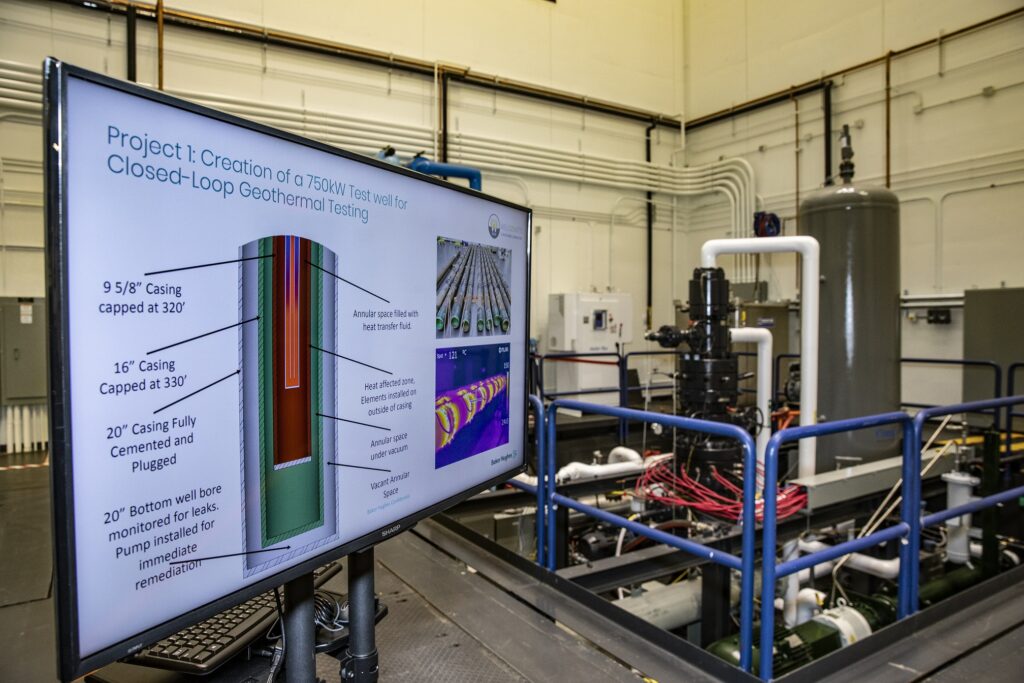
Menon highlighted that many of the technologies developed for conventional geothermal have crossover applications to EGS. Baker Hughes has the largest installed base of geothermal Electric Submersible Pumps (ESPs) globally, and have worked extensively improve this technology. The work that the company has done on designing high-temperature, high-flow ESPs and improving the reliability of these systems, by mitigating scale formation for instance, can benefit both EGS and conventional geothermal systems.
“It all goes back to the whole S2S paradigm,” Menon said. “Operators will want to take into account all the parameters of running an EGS project. This includes understanding the characteristics of the geothermal fluid and how it behaves after it has exited the wellbore. Good design of surface facilities is just as important in ensuring an efficient project.”
A growing awareness of EGS and geothermal
In parallel with technological advancements, the geothermal sector is witnessing a significant shift in public and institutional awareness. A decade ago, geothermal was rarely mentioned in energy policy discussions. Today, EGS features prominently in conversations around energy security, baseload renewables, and decarbonization.
“The fact that people outside the industry now ask about geothermal and EGS is a big change,” said Menon. “We’re seeing coverage in the media, government programs, and investor interest all rise sharply.”
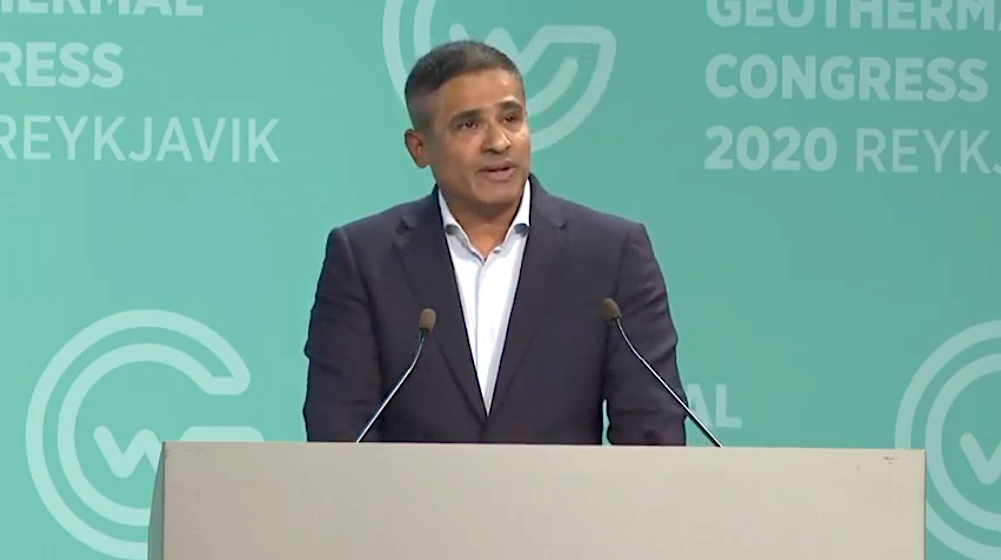
Menon also noted that the broader energy demand landscape is favorable to geothermal. With rising global electricity demand, all power generation sources are under pressure to expand. Unlike nuclear or other renewables, geothermal is very scalable in the near-term using existing oilfield infrastructure and a trained workforce.
Baker Hughes is playing a pivotal role in enabling the next generation of geothermal energy through technologies that help scale EGS projects, as well other geothermal plays. By drawing from decades of experience in both geothermal and oil and gas, and by investing in purpose-built solutions, including fracture modeling, drilling technology, ESP systems, and integrated workflows, the company is helping transform EGS into a commercially viable and globally scalable energy solution.