A look back at 2025: ThinkGeoEnergy’s Top 10 most-read geothermal news stories
 ThinkGeoEnergy's Top 10 most-read geothermal news stories for the year 2025


 Carlo Cariaga
2 Feb 2026
Carlo Cariaga
2 Feb 2026
ThinkGeoEnergy's Top 10 geothermal news stories for the year 2025 highlight positive momentum for geothermal across several fronts.
As we always do at the start of every year, we have taken a look at our website traffic analytics to create a list of the Top 10 most-read geothermal news stories. Seeing which companies or projects get the most reader engagement is just another way to see how the industry is evolving, especially with new players and regions joining the sector. This list covers January to December 2025
As usual, our Global Geothermal Power Plant Map still attracts the highest traffic out of all our website pages. We have also gotten great traffic numbers on our Geothermal 101 page, which we made great effort to revamp and update last year. We invite everyone who would still like to learn more about the basics of geothermal to take a look at this section. We wrote this through our own unique perspective as a media organization that has been looking at the geothermal sector for almost two decades.
This list is a nice little treat that we prepare for our readers to show our appreciation. Thank you to everyone who reads, shares, and engages with our articles! With that out of the way – on to the Top 10!
NOTE: The list is solely based on our website traffic figures for the year 2025. We have no control over the demographics of our audience, nor the pages they choose to access.
The Top 10 Geothermal Stories of 2025
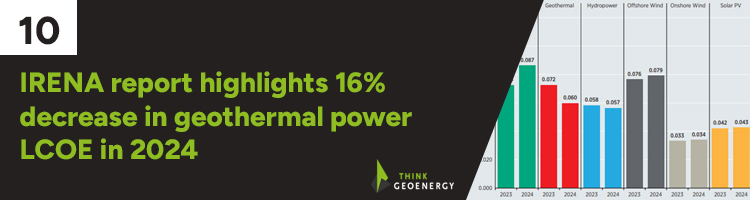
Coming on the 10th spot is a story on the report published by IRENA that highlights the reduction of the Levelized Cost of Electricity (LCOE) of geothermal power from USD 0.072/kWh to 0.060/kWh. There is plenty of nuance needed to understand the implication of these figures, so we recommend reading the article in its entirety.
In a nutshell, the drop in LCOE is a good sign for the geothermal power sector. However, the low number of geothermal power projects that come online per year means that the value will fluctuate significantly if viewed on a year-to-year basis. Development is naturally concentrated on mature markets like New Zealand, Indonesia, and Türkiye which will have very different LCOE values compared to emerging geothermal regions.
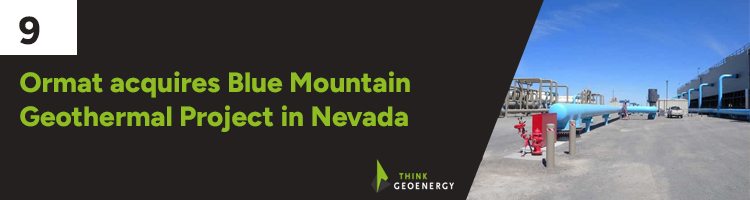
The next story is the acquisition of the Blue Mountain geothermal project in Nevada by Ormat Technologies. This story is interesting because of the long history of challenges of the Blue Mountain facility, which in turn has resulted in multiple rounds of acquisition.
According to Ormat, the plan now is to upgrade the power plant to increase its capacity and augment it with a solar power facility. It will be part of the company’s development pipeline, although no further details were given on whether there will be further drilling or exploration work. Is the acquisition a guarantee that the Blue Mountain facility will be revived to its full potential? Only time will tell, but it seems to be in good hands for now.
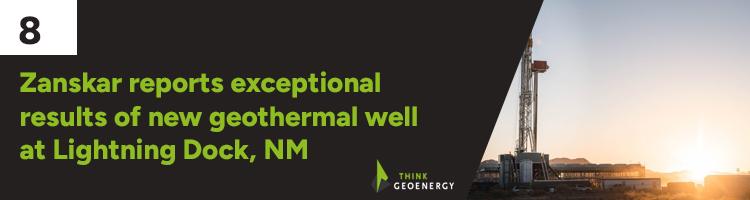
Story number 8 is the discovery of a highly productive well at the Lighting Dock geothermal field in New Mexico by Zanskar. The story is interesting in many ways. It shows that there are still high-potential hydrothermal resources that are yet to be discovered, even in a known geothermal field. It also validates Zanskar’s geothermal discovery technology.
Zanskar has since gone on to discover high-temperature geothermal resources at two other sites in Nevada. The company is remaining steadfast to their thesis that conventional geothermal systems can still be developed using new exploration methods. This is a refreshing departure from the current narrative focusing on EGS and AGS projects. Zanskar has built excellent momentum, and we’re looking forward to their new discoveries.
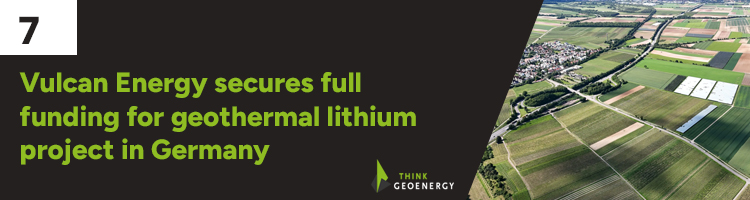
The next story came out just before the year ended – the Final Investment Decision made by Vulcan Energy for their combined geothermal energy and lithium project in Germany. This is a culmination of years of work done by the company in securing funding for their project. The final blended financing package is a combination of grants, loans, and equity investments from several partners.
The development is a major milestone for the project which promises to supply lithium hydroxide monohydrate for 500,000 electric vehicles per year, plus over geothermal heat and power for the nearby communities. It represents a new model for revenue diversification in geothermal projects, although it’s not the only company working on this concept. Will Vulcan be first-to-market for geothermal-derived lithium? We are also excited to find out.
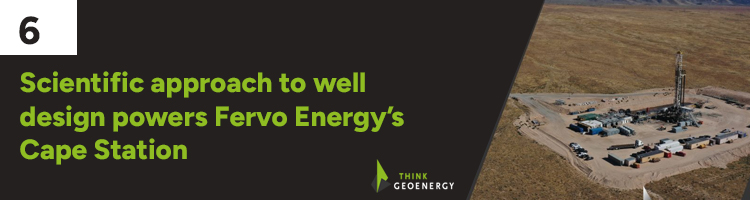
Is it even possible to write a Top 10 of anything geothermal-related without mentioning Fervo Energy? The company has been the darling of the general public interested in geothermal, as well as service providers, equipment manufacturers, and investors. This particular feature article focuses on Fervo’s scientific approach to drilling and well construction that has resulted in impressive improvements in drilling time at the Cape Station project. The article was written with help from engineering services provider Halliburton.
We are expecting the first 100 MW of the Cape Station project to go online this year, with the next 400 MW following over the next few years. With decades of research and projects done on EGS, we are very happy to finally see this technology deployed at such a scale.

At the start of the year, the US Department of Defense announced a small selection of companies that the agency deemed awardable for geothermal projects in its branches and facilities. It’s a veritable who’s who of the geothermal companies in the US, so check out the list here.
What makes this story special? The novelty lies in the fact that it is the DoD initiating possibly a series of geothermal projects to be deployed at their sites around the USA. It shows massive government support, and also emphasizes the energy security angle of geothermal. If the DoD is looking towards geothermal to provide safe and stable power, then that’s a massive vote of confidence for the sector. Geothermal projects in partnership with DoD have since started and more are expected to come, given the support that the current administration has expressed.
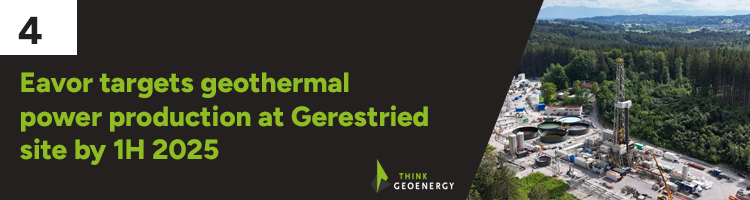
As we stated in last year’s Top 10 article, Eavor is a company that has managed to capture the attention and imagination of the general public about geothermal in a way that few companies have in the past. This year, the company’s commitment of delivering power from the Geretsried site in Germany once again makes the Top 10 list. Though the company ultimately had to move the target, they eventually were able to deliver the first power from the site before the end of 2025.
Though the Gerestried story is far from over, we are happy that Eavor has reached this milestone. It is the penultimate demonstration that the concept works, at least on a technical level. The facility has not reached full capacity yet, and reports indicate that there are plans to drill more loops this year. We will continue to keep an eye on the progress of this advanced closed-loop geothermal project.
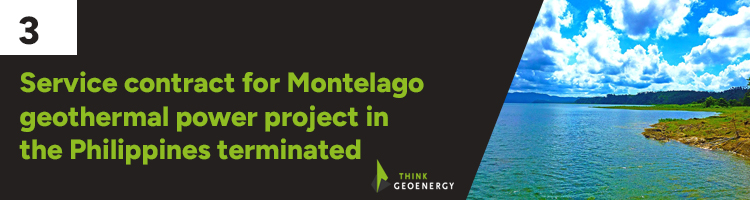
Not all of the top geothermal stories are good. Sometimes they represent the culmination of years of resource assessment that simply cannot progress to commercial development just yet. This is the case for the revocation of the service contract for the Montelago geothermal site in the Philippines. As Emerging Power Inc has concluded, the site does not support an economically viable project due to low mass flow.
Having this kind of story so far up the list offers a sobering realization. Geothermal resources may theoretically exist anywhere, but the conditions that allow for their commercial development may be absent. Whether it’s the quality of the resource, logistical complexities, market dynamics, national or social issues, or lack of government support, geothermal projects around the world have failed for a myriad of reasons. Montelago will not be the last geothermal project to fail, and that is a fact that the sector must be at peace with.
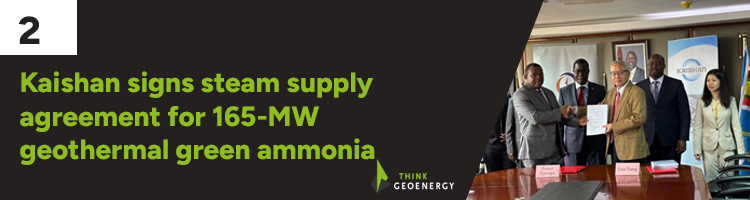
For the next story, we go to Kenya for the signing of a geothermal supply agreement for a green ammonia facility to be built by the Kaishan Group. The story is important in many ways. The contract represents an avenue for diversification of ways to utilize geothermal power. The supply agreement also ensures a large-scale off-taker for the geothermal steam from KenGen, thus providing security for further investment and expansion.
An argument can be made that the past few years have been very kind to the geothermal sector of Kenya. Based on the progress of the power plants in Menengai, the country will soon be joining the vaunted 1-GW Geothermal Club. Aside from stellar capacity growth, the country had also just been recently selected to host the next World Geothermal Congress. Kenya remains one of the most exciting markets to watch in the global geothermal sector.
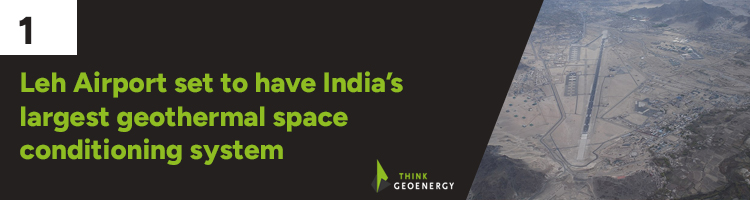
The Top 1 story of the year is a bit unconventional, but also not surprising. The story highlights ongoing work for a geothermal system that will provide heating, cooling, and hot water supply to the Leh Airport. Compared to many other countries on this list, India is not exactly well-known for geothermal. However, India is slowly developing geothermal in many fronts – for power generation, heating and cooling, and cold storage.
Many of the potential geothermal sites in India are located in remote areas. These are typically low-temperature sites that can be harnessed for heating and cooling. This simply means that such geothermal projects are well-positioned to provide meaningful benefits and improve the quality of life of small communities. However, the country currently is also working on large-scale projects, starting with the geothermal drilling being done in Ladakh.