What Fervo and CTR reveal about geothermal valuations
 Steam testing at the site of the Hell's Kitchen geothermal project in Imperial County, California (source: CTR)


 Alexander Richter
11 Mar 2026
Alexander Richter
11 Mar 2026
What do the Fervo IPO and CTR’s valuation reveal about geothermal markets? Download the ThinkGeoEnergy Market Brief for a capital markets perspective.
Recent geothermal transactions in the United States are offering a rare glimpse into how public equity markets currently view the sector. Two deals in particular have attracted attention: the planned initial public offering (IPO) of Fervo Energy and the announced business combination involving Controlled Thermal Resources (CTR), which implies an enterprise valuation in the range of USD 4-5 billion.
Taken together, these transactions highlight how investors increasingly differentiate between geothermal business models. While both companies rely on geothermal resources, the way their businesses are framed in capital markets discussions appears to influence how investors approach valuation.
A recent ThinkGeoEnergy Market Brief explores these dynamics in more detail, which you can find here.
Technology-led geothermal platforms
Fervo Energy has emerged as one of the most closely watched geothermal companies in the private market. The company applies technologies widely used in the unconventional oil and gas sector, including horizontal drilling, fibre-optic sensing and data-driven reservoir management, to enhanced geothermal systems (EGS).
The company is positioning itself as a technology-enabled geothermal platform capable of delivering scalable firm power in areas not traditionally associated with geothermal resources. Its projects are intended to demonstrate that modern drilling techniques and subsurface analytics can unlock repeatable geothermal development.
From a capital markets perspective, however, such platforms are often viewed as technology-driven growth companies rather than traditional power producers. Investors must evaluate questions around scalability, drilling performance and the pace at which costs may decline as projects are replicated.
As a result, technology-led geothermal platforms can attract significant strategic interest while still facing cautious valuation assumptions during early commercial scaling.
Geothermal plus critical minerals
The business model around Controlled Thermal Resources (CTR) presents a different investment narrative. The company’s flagship Hell’s Kitchen project in California integrates geothermal power generation with lithium and other critical-mineral extraction from geothermal brines.
In public discussion of the project, geothermal is often framed primarily as enabling infrastructure. The geothermal resource provides heat, power and brine management for the lithium production process, helping reduce both emissions and operating costs.
For investors, this framing connects the project to broader themes such as electric-vehicle supply chains, battery manufacturing and industrial policy support for domestic critical-mineral production.
Valuation discussions therefore tend to reference lithium developers and battery supply-chain projects rather than traditional geothermal power companies.
Geothermal’s uneven history in public markets
Geothermal energy has a long operational track record, but a relatively uneven history in public equity markets. A small number of companies, most notably Ormat Technologies, have maintained stable public listings with diversified portfolios of geothermal plants and services businesses.
Earlier cycles have been less successful. During the mid-2000s, a wave of geothermal developers listed on exchanges such as the Toronto Stock Exchange and TSX Venture Exchange based largely on exploration potential. Many of these companies later struggled as subsurface risk, permitting challenges and cost overruns became apparent.
This experience remains part of the sector’s collective memory among investors and helps explain why geothermal projects are often assessed with caution compared to other emerging energy technologies.
A frontier energy paradox
This cautious approach has created what some observers describe as a paradox in the energy-transition landscape. Several frontier energy technologies, including advanced nuclear, hydrogen and fusion, have achieved substantial valuations long before large-scale commercial deployment.
Geothermal technologies such as enhanced geothermal systems or closed-loop concepts, by contrast, build on decades of drilling and subsurface engineering experience and target markets where demand is already clear, including firm power and industrial heat.
Yet geothermal platforms often face more conservative valuation assumptions because drilling risks, capital requirements and project timelines are highly visible and relatively easy for investors to model.
Business model matters for valuation
The contrast between recent transactions suggests that business model positioning plays an important role in how geothermal companies are assessed in capital markets.
Projects framed within established investment narratives—such as critical minerals, infrastructure portfolios or industrial decarbonisation—may benefit from familiar valuation frameworks. Technology-driven geothermal platforms, meanwhile, must often demonstrate operational performance and cost reductions before being valued more like infrastructure assets.
In practice, companies that successfully transition from early-stage technology development toward diversified project portfolios and contracted revenue streams may find public markets more receptive.
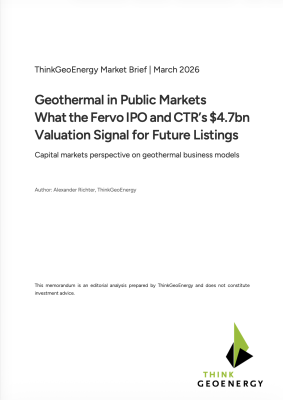 Download the full Market Brief
These themes are explored in greater detail in the ThinkGeoEnergy Market Brief “Geothermal in Public Markets.” The briefing examines how investors are currently interpreting geothermal business models and what recent transactions may signal for future geothermal listings.
The note looks at the emerging role of geothermal within the broader energy-transition investment landscape and the factors that may shape future geothermal IPOs.