UK Geoenergy Observatory investigates use of acoustic sensing for shallow geothermal monitoring
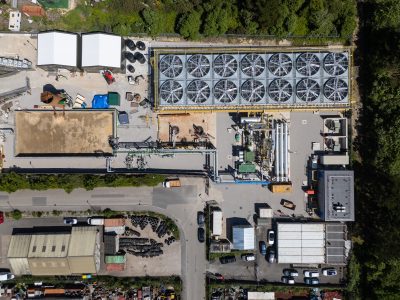
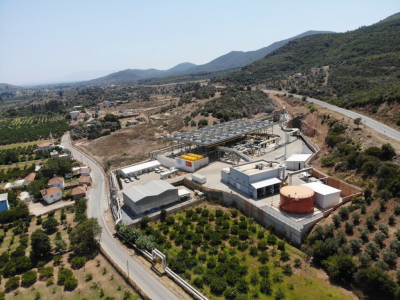
 Aerial view of the UK Geoenergy Observatory in Cheshire (source: BGS)


 Carlo Cariaga
14 Nov 2025
Carlo Cariaga
14 Nov 2025
Ongoing research at the UK Geoenergy Observatory in Cheshire is investigating the use of acoustic monitoring to detect thermal changes in geothermal systems.
Studies are ongoing at the UK Geoenergy Observatory in Cheshire to investigate the use of distributed acoustic sensing (DAS) to detect subsurface temperature changes in geothermal environments.
DAS sensing has already been used extensively in many subsurface settings, but it is yet to be widely developed for monitoring of shallow geothermal operations. The current study uses a high-resolution, fibre-optic DAS sensing system installed in the boreholes at the Cheshire observatory.
The research is being led by scientists from the University of Leeds as part of the NERC-funded SmartRes project.
“It’s been very exciting to undertake the first DAS survey at the Cheshire Observatory. Fibre-optic technologies like DAS are giving us unprecedented insight into many subsurface processes. For geothermal applications, the insight is really timely: we need to demonstrate to prospective stakeholders that we understand how subsurface properties will evolve under various heating scenarios,” said Prof Adam Booth, associate professor of applied geophysics at the University of Leeds.
Baseline data collection
Baseline measurements have been done during two days of surveying back in June 2025. During this phase, over 1000 seismic impacts from a controlled energy source were made. These were then recorded by the 5-km fibre-optic network installed in the boreholes. Strong seismic signals were visible at all depths, providing an encouraging seismic baseline for future thermal testing.
For subsequent test, researchers will be monitoring variations in the arrival time of acoustic waves, and evaluating whether such changes are indicative of where heat is moving in the subsurface.
Initial analysis of the data recorded at the site validates the potential of the technology for high-resolution monitoring of the Sherwood Sandstone group aquifer. This will contribute to a wider understanding of geothermal processes and inform the design of efficient geothermal heating systems.
Source: British Geological Survey