Research in Thurgau, Switzerland provides valuable insight on geothermal resource
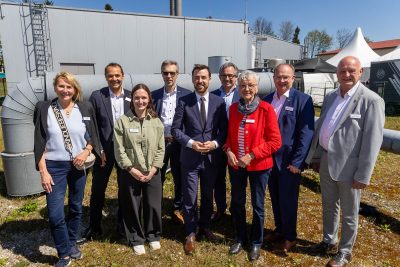
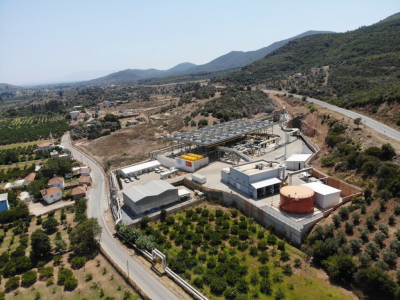
 Prime Minister Walter Schönholzer with representatives of Grob Gemüse, University of Bern, and SFOE at the geothermal greenhouse in Schlattingen, Thurgau, Switzerland (source: Canton of Thurgau)


 Carlo Cariaga
21 Apr 2025
Carlo Cariaga
21 Apr 2025
Research being done on two geothermal boreholes in the Schlattingen region of Thurgau, Switzerland has provided crucial insight on the geothermal resource.
A geothermal research project in the Canton of Thurgau in Switzerland has been running for two years, and has provided some important information on the subsurface and the characteristics of the geothermal resource. Findings from the research will be crucial in helping identify other suitable locations for geothermal use, particularly in the area around Schlattingen.
An important element in this geothermal research project is the existence of two deep boreholes that are currently providing heat to greenhouses in Schlattingen. Since 2022, Grob Gemüse AG has been using these two geothermal boreholes. Water from these boreholes has a surface temperature of 64 °C, which then provides heating to greenhouses. The system helps save around half a million liters of heating oil per year.
An opportunity for geothermal research
Moreover, the boreholes are drilled into the Muschelkalk at 1200 meters depth, a water-bearing clay and limestone formation that hosts the geothermal resource in the area. This provides an opportunity to gain insight on the resource. Therefore, the Canton of Thurgau submitted a research project to the Swiss Federal Office of Energy (SFOE) in 2022.
“The goal is to understand how this geothermal reservoir works and thus increase the chances of success for the future use of geothermal energy,” emphasized Philippe Müller, Head of the Energy Research and Cleantech Section at the SFOE.
The SFOE and the Canton of Thurgau are sharing the costs. Grob Gemüse AG, for its part, is making the boreholes available for scientific purposes. The research work, led by the University of Bern, began in early 2023 with the collection of water samples.
Insights from the geothermal fluids
Comprehensive analyses show that the water from the two boreholes has different origins. Borehole 1 was drilled vertically, while borehole 2 was deviated, so that the catchments are located approximately one kilometer apart.
The water from the vertical borehole comes from precipitation that fell during the last Ice Age in the Wutach Valley region of the southern Black Forest. This is where the water-bearing carbonate layer, located in Schlattingen at a depth of approximately 1,200 meters, rises to the surface. The precipitation was able to seep in at this point. Interestingly, a significant proportion of the water from the deviated borehole 2 comes from the crystalline basement, i.e. from rock layers that are even deeper.
Dr. Christoph Wanner, scientific director of the project from the University of Bern, explained that this can be proven beyond doubt by, among other things, increased concentrations of helium and lithium.
The chemical composition of the water from borehole 2 is similar to the thermal water in Schinznach, Baden, or Riehen. Because it originates from deeper layers, one would expect a higher temperature. However, the difference to the water temperature from borehole 1 is very slight. This suggests that the water must have cooled on its way to the extraction point.
This means that the site of water ascent from the crystalline basement is far from the water intake of borehole 2, or the water is rising only slowly. Such water ascents from the basement occur along fault zones, i.e., in cracks and crevices. One such fault zone, the “Randen Fault,” is located near the boreholes. There, the rock layers have been shifted or displaced due to forces in the Earth’s interior. The closer a borehole is to fault-related water ascent zones, the higher the water temperature should be.
“Fault zones are therefore of particular interest for this type of geothermal energy use, so-called hydrothermal geothermal energy,” explained Dr. Christoph Wanner.
The findings from the research project to date are being incorporated into two models. The first model simulates groundwater flows in the immediate vicinity of the two boreholes. The second model also considers fracture networks near fault zones to better understand the rise of groundwater from the crystalline basement. The models provide a clearer picture of the water-bearing rock layers for the area around Schlattingen, but are also valuable for the canton of Thurgau.
The research project will be completed in autumn 2025. The new insights into the subsurface will facilitate decisions to identify other suitable locations for the use of geothermal energy, thus increasing the chances of success for future geothermal projects in the canton.
Source: Canton of Thurgau