Growing geothermal momentum in focus at the 3rd Budapest Geothermal Energy Summit
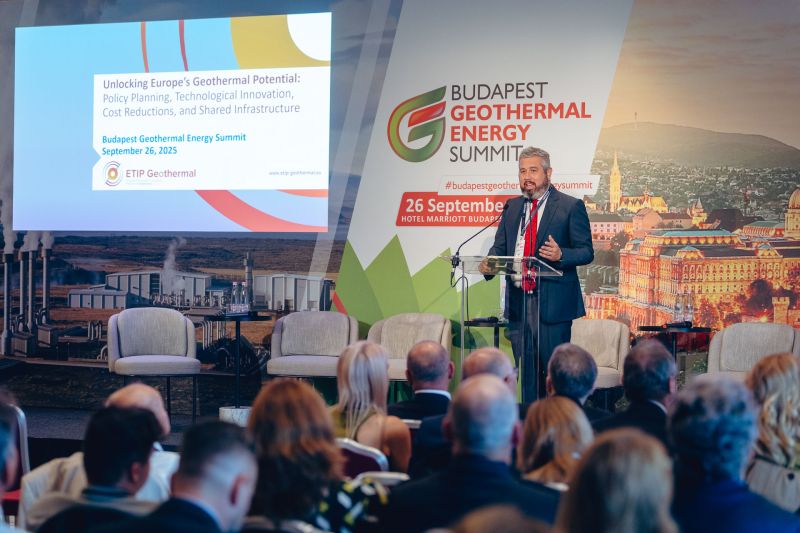
 Csaba Lantos, Minister of Energy of Hungary, speaking at the 3rd Budapest Geothermal Energy Summit (source: Budapest Geothermal Energy Summit)


 Carlo Cariaga
30 Sep 2025
Carlo Cariaga
30 Sep 2025
The 3rd Budapest Geothermal Energy Summit once again gathered participants from 20 countries to discuss the momentum and challenges of the geothermal industry.
Representatives from 100 companies across 20 countries gathered again at the 3rd Budapest Geothermal Energy Summit, the leading geothermal conference in the CEE/SEE region. The event took place in Hotel Marriott in Budapest, Hungary under the organization of White Paper Consulting, and provided a platform to discuss the potential and critical role of geothermal energy in the energy transition.
A growing momentum for geothermal in Hungary
“We’ve never seen so much geothermal extraction as today,” said Csaba Lantos, Hungary’s Minister of Energy, in his opening speech highlighting trends, challenges, and opportunities in geothermal energy development in Hungary. The Minister pointed out that the share of geothermal in heat generation could from the current 6.5% to 25-30%, thus displacing 1 billion cubic meters of natural gas by 2035. Moreover, the Hungarian Government has set a national strategy to double geothermal output to 12-13 PJ by 2030.
There is also momentum among the general public for geothermal, as pointed out by Bence Gonda, Vice President for Strategic Affairs at the Supervisory Authority for Regulatory Affairs of Hungary (SZTFH). He also pointed out that the Hungarian National Geothermal Utilisation Concept was one of the first in the European Union.
“Geothermal is now,” remarked Luca Xodo, Chairman of ETIP Geothermal, adding that we have an advantage in Europe: we are still at the first tier, with the lowest-hanging fruits to capture in heat generation, and in some cases even in electricity generation.
Miklos Antics, President of the European Geothermal Energy Council (EGEC), also gave insights into the present status and the future of geothermal development in Europe. According to him, the organization’s target is move from megawatts to gigawatts – increasing the contribution of geothermal to 75% for heating and cooling, 65% for agrifood, 15% for electricity, and 10% for critical raw materials.
Eliminating the bottlenecks for geothermal
In a roundtable on eliminating geothermal bottlenecks, panellists discussed financial, technological, and social challenges. Suzana Carp, the Co-Founder of Cleantech for Central and Eastern Europe said, that the region has the best potential for geothermal energy in Europe. There is momentum, but a regional strategy is lacking. The fragmentation actually hinders progress, slowing development in each country.
Viktor Horváth, Deputy State Secretary for Energy and Climate of Hungary stressed that it’s important to look at the entire value chain. Beata K?pi?ska, Chair of the Polish Geothermal Society, drew attention to the challenge of water management.
“Electricity and heat production attract different types of investors,” said Martina Tuschl, Director of Geothermal Energy Sector at the Croatian Hydrocarbon Agency. She further explained adding that electricity projects require investors with equity due to their high risk, while heating projects are often supported by local communities, who are eager to participate in energy initiatives for their areas.
Gábor Molnár, Managing Director at Arctic Green Engineering Services, highlighted the importance of accurate predictions: “It is crucial to have the best possible forecasts for the expected parameters to minimise changes during construction activities.”
Activating the entire value chain
“We have to figure out how to make it profitable,” said Gergely Domonkos Horváth CEO at MVM Zöldgeneráció about market development, adding that ESG considerations can help. According to Tamás Pazsiczky, Partner, EY-Parthenon collaboration along the value chain is critical. “Offtakers must be proactive, educated, and engaged.” Tímea Ladi, Head of Geothermal and New Energies MOL said, that companies need to understand that current gas prices are not the only consideration. Supply security, local availability, and other key factors are equally important.
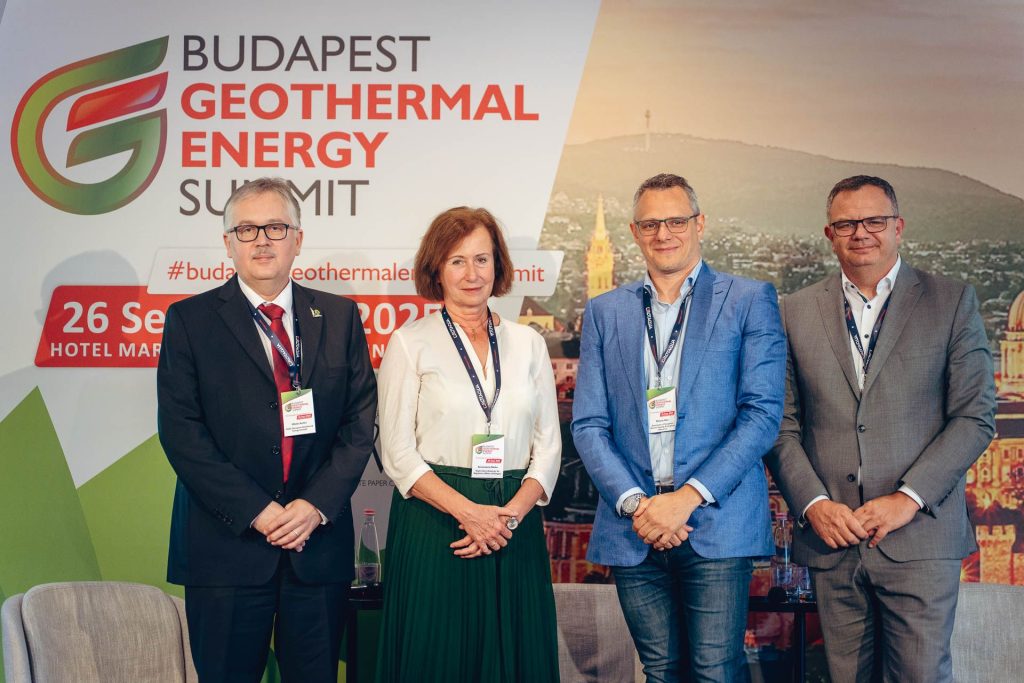
Csaba Kiss Ph.D., Deputy CEO at MVM, discussed the dual need for producing heat and electricity: “Power generation in Hungary must go hand in hand with heat sales, as this provides a reasonable return on the risks involved in geothermal exploration and drilling.”
Prof. Dr. Inga Moeck, board member of the Bundesverband Geothermie, underlined that municipalities are responsible for heat distribution, but not for drilling, exploration, or project development. “We need to activate the major energy providers,” she pointed out.
Imre Pinczés, Drilling Manager at Rotaqua Ltd., highlighted the company’s recent progress in geothermal deep drilling, including a major rig investment, six completed projects, and overcoming complex geological conditions. He also addressed key challenges such as deeper-than-planned wells and unexpected geological formations impacting project execution.
Florian Vonas, Head of Geothermal Division at Bayer Construct, gave an overview of the geothermal projects of Bayer: “Although we are still relatively new to the geothermal market, in a short time we have made significant progress and established a strong position within the Hungarian geothermal sector.”
At the roundtable, experts emphasized the growing recognition of geothermal potential by municipalities and authorities, while also highlighting the importance of sharing private sector expertise with local communities. The discussion concluded with a call for research, innovation, and practical solutions to advance geothermal heating and cooling systems.
RELATED: Hungary builds capacity through the first Geothermal Short Course in Budapest
Source: Email correspondence