Germany: geothermal heat defies price surge
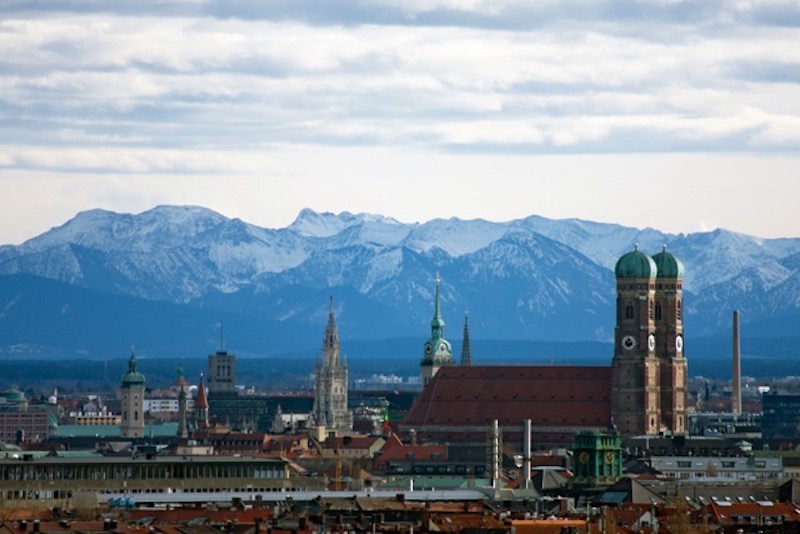 View over Munich, Germany (source: Praxisforum Geothermie.Bayern/ Enerchange)


 Alexander Richter
24 Feb 2026
Alexander Richter
24 Feb 2026
As district heating prices rise again in Germany, deep geothermal networks in Bavaria report stable costs for the 2025/26 heating season.
District heating prices are rising again across Germany, driven by higher fuel costs, CO2 pricing and infrastructure investments. Against this backdrop, deep geothermal district heating networks in Bavaria are reporting largely stable prices for the 2025/26 heating season.
This is the central finding of a new market analysis by the the Praxisforum Geothermie.Bayern (now Praxisforum TiefeGeothermie), covering 18 geothermal-based district heating networks in the state.
District heating costs rising nationwide
Recent market assessments show that many German households connected to district heating networks are facing renewed price increases. Conventional district heating systems in Germany still rely heavily on natural gas, coal, and waste incineration. Rising CO2 certificate prices and higher procurement costs are feeding through to end customers.
According to consumer and market monitoring data, fossil-based heating systems are seeing noticeable cost increases this winter. Gas heating costs have risen sharply, with increases in the mid-teens percentage range reported in recent analyses. Oil and conventional district heating are also trending upwards.
In this broader context of increasing heating expenses, the Bavarian geothermal data presents a contrasting picture.
Stable prices in geothermal networks
Eighteen district heating networks in Bavaria are currently supplied by deep geothermal plants. While the geothermal share differs between systems, the analysis shows that price movements have remained minimal compared to other heating technologies.
Following an average price reduction of 3.4 percent in the previous heating season, the 2025/26 figures show:
- Detached house, 27,000 kWh/year: average increase of 0.08 percent
- Apartment (10-unit building), 16,000 kWh/year: average increase of 0.54 percent
These increases are significantly below the price adjustments observed in fossil-based systems.
The median price for district heating from deep geothermal sources in Bavaria stands at 13.4 euro cents per kWh. For comparison, recent consumer data indicates a nationwide median of around 17 cents per kWh for district heating overall, much of which is still fossil-based.
Local price movements reflect investment cycles
The analysis also highlights variations between operators.
AFK Geothermie, supplying more than 1,700 households and businesses in Aschheim, Feldkirchen, and Kirchheim near Munich, reduced prices by 5.8 percent. Taufkirchen recorded a 2.9 percent decrease, and Ismaning 1.8 percent.
In the model calculation for a single-family home with 27,000 kWh annual consumption, these reductions correspond to savings of roughly EUR 70 to EUR 270 per year.
At the other end of the spectrum, Stadtwerke Waldkraiburg increased prices by eight percent. The municipal utility attributes this to the construction of a new heating plant, expansion of the district heating network, and higher financing costs linked to a planned second geothermal facility.
Despite this increase, Waldkraiburg remains among the lower-cost providers, at 12.60 cents per kWh in the single-family home example.
The lowest prices in the 27,000 kWh scenario were recorded in Kirchweidach at 11.25 cents per kWh, followed by Grünwald, Unterföhring, Pullach and Garching near Munich.
Infrastructure and geothermal share drive differences
The analysis shows substantial differences between networks. In the single-family home example, the gap between the lowest and highest annual heating costs exceeds EUR 1,700.
According to the Bavarian Geothermal Forum, these differences are linked to local framework conditions. Systems that could rely on existing district heating infrastructure generally offer lower prices than those requiring full network expansion. The geothermal share in the heat mix is also decisive. A higher geothermal contribution reduces exposure to fossil fuel price volatility and CO2 costs.
Expansion supported by policy reforms
Germany’s roadmap for deep geothermal energy estimates that up to 25 percent of total national heat demand could be covered by deep geothermal resources.
Recent policy measures such as the Geothermal Acceleration Act, revised federal funding programmes, and new KfW financing instruments with integrated drilling risk coverage are intended to support further deployment.
As heating costs rise across much of the country, the Bavarian market analysis suggests that deep geothermal district heating offers comparatively stable pricing conditions within Germany’s evolving heat market.
Source: Praxisforum TiefeGeothermie via our German partner website tiefegeothermie.de