Geothermal the key to Türkiye’s energy independence
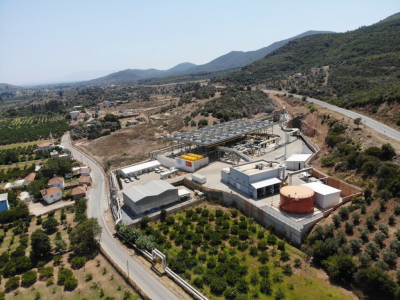
 Balikesir Gönen Agriculture Based Specialized Greenhouse Organized Industrial Zone (source: Gönen TDIOSB)


 Carlo Cariaga
22 Apr 2026
Carlo Cariaga
22 Apr 2026
JED Chairman Ali Kindap emphasized that Türkiye's dependence on imported energy must be rapidly reduced, with geothermal presented as a solution.
In the face of another oil crisis restricting the global oil and natural gas supply, Ali Kindap, Chairman of the Board of Directors of the Geothermal Energy Association (JED), reminded that Türkiye needs to accelerate its renewable energy development to reduce its dependence on imported sources.
As the only renewable energy resource that offers baseload capacity, geothermal plays an important role in energy diversification, supply security, and the clean energy transition.
Kindap further stated that Türkiye is 97% dependent on natural gas imports, and that its share in electricity production is around 20%. When considered together with imported coal, about 1/3 of the electricity production in Türkiye is dependent on imported resources. Thus, the country needs to accelerate its steps in its renewable energy journey.
The only renewable source in the base load position
Kindap emphasized that geothermal energy is the only renewable resource in a baseload position, and stated that all companies investing in the sector are ready to take responsibility in order to create much higher added value for Türkiye.
The Chairman noted that the use of geothermal energy, especially for residential heating, is rapidly increasing in European Union countries. However, he also pointed out that the geothermal resource efficiency in these countries is incomparably lower than in Türkiye.
“Scientific research shows that 43,000 MW of new geothermal capacity can be developed among the member states of the European Union. The International Energy Agency and energy think tanks indicate that if this capacity is realized, geothermal energy has the potential to replace approximately 42 percent of the electricity produced from coal and gas in the EU,” said Kindap.
“As Türkiye, we have more geothermal resource potential than all of Europe. However, as long as this resource remains untapped, it does not serve the development of our country. Geothermal energy, which is poised to play a key role in our country’s move away from imported energy sources and in the clean energy transition, is of strategic importance for our energy security and climate goals.”
Electricity generation from geothermal sources could triple
Kindap reminded that as Türkiye currently has a geothermal energy usage level of 20,000 MWth in areas such as energy production, greenhouse farming, residential heating, and thermal tourism.
Stating that this level is less than one-third of the discovered potential, Ali Kindap said, “We can triple our current geothermal electricity production of 1760 MWe to over 5,000 MWe, increase the number of homes heated with geothermal energy from 170,000 to 1 million, and expand our geothermal greenhouse area from 7,000 acres to 100,000 acres.”
He further stated that they view the increase in installed geothermal power capacity not just as a numerical growth, but as a reflection of sustainable energy policies that consider environmental impacts. He emphasized that for Türkiye to achieve its ‘Net Zero 2053’ vision, it needs to increase its installed geothermal power capacity by approximately five times, reaching 10,000 MWe.
The Turkish geothermal energy sector in numbers
- Türkiye has reached an installed capacity level of 1758 MW in geothermal electricity generation and ranks fourth in the world and first in Europe.
- Türkiye has slightly over 7,000 MW of geothermal energy usage in areas such as energy production, residential heating, geothermal greenhouses, thermal tourism, geothermal fishing, and fruit and vegetable drying.
- While the Mineral Research and Exploration Institute (MTA) states that Türkiye’s discovered geothermal potential is 62,000 MWth, according to data from the Ministry of Energy and Natural Resources, Türkiye currently utilizes less than one-third of this potential, at 19,836 MWth.
- Türkiye, which has a potential of 150,000 acres of geothermal heated greenhouses, currently has only 7,000 acres. With this capacity, which is at 5% of its potential, Türkiye ranks 7th in the world and 1st in Europe.
Source: Direct correspondence via our Turkish language platform JeotermalHaberler