Nga Tamariki Unit 5 geothermal power plant in New Zealand starts grid supply
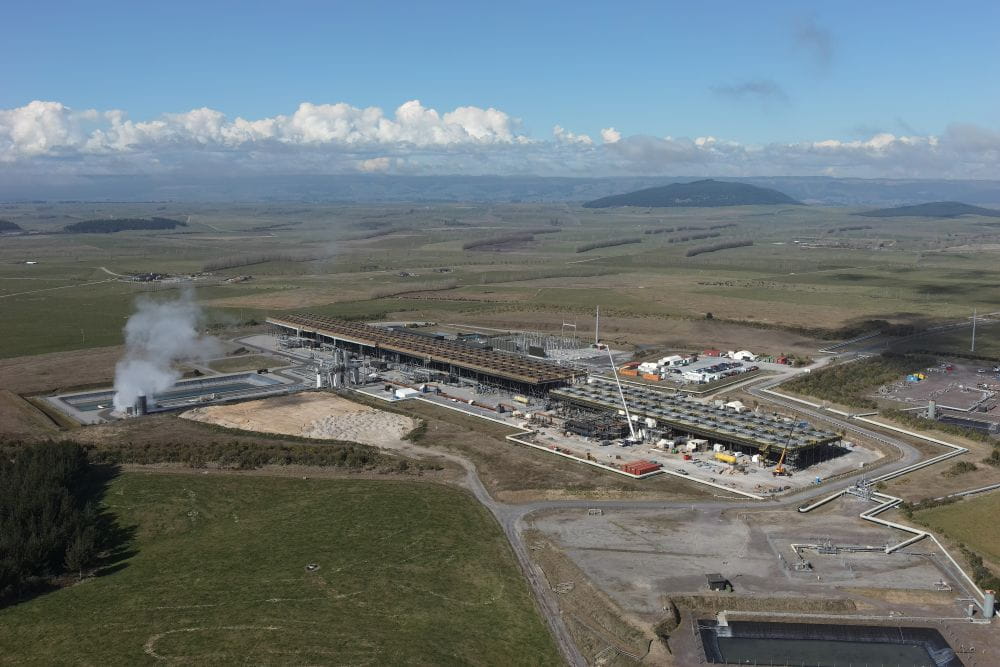 The Nga Tamariki geothermal power station in New Zealand (source: Mercury)


 Carlo Cariaga
21 Jan 2026
Carlo Cariaga
21 Jan 2026
The 46-MW expansion unit of the Nga Tamariki geothermal power station in New Zealand is scheduled to be fully operational by March 2026.
The fifth unit of the Nga Tamariki geothermal power station, operated by Mercury, has officially started supplying electricity to the grid. Commissioning of the power plant is still underway and is expected to be completed by March 2026, ahead of the winter season in New Zealand. When completed, the unit will deliver 46 MW of net capacity and increase the total capacity at Nga Tamariki from 86 MW to 132 MW.
According to Mercury CEO Stewart Hamilton, the new power generating unit will provide power equivalent to the demand of 55,000 homes. The $220 million project was first announced at an investor presentation back in September 2023. The selection of Ormat Technologies as the EPC contractor for the project was announced soon after. By March 2024, a groundbreaking ceremony was held to signal the start of construction work. The expansion project was done with partners Tauhara North No.2 Trust and mana whenua Ngati Tahu Ngati Whaoa.
The first four units of Nga Tamariki were commissioned in 2013, following a drilling campaign that started in 1985 and further expanded in 2008 and 2009. It was the first geothermal power station in New Zealand to implement NCG reinjection. Mercury states that the reinjection workstream will also be integrated into the fifth unit in 2026, thus completing the $3.3 million reinjection programme.
New Zealand currently has a very active pipeline of geothermal power projects under construction or about to come online. Similar to Nga Tamariki, the 49-MW TOPP2 geothermal power plant of Eastland Generation announced grid synchronization back in December 2025 and an imminent start of full capacity operations. Meanwhile, construction is ongoing for the 101-MW Te Mihi 2 geothermal power plant of Contact Energy, which is expected go online by 2027.
Source: RNZ and Stewart Hamilton via LinkedIn