Fervo highlights stable operations of Project Red geothermal project after 600 days
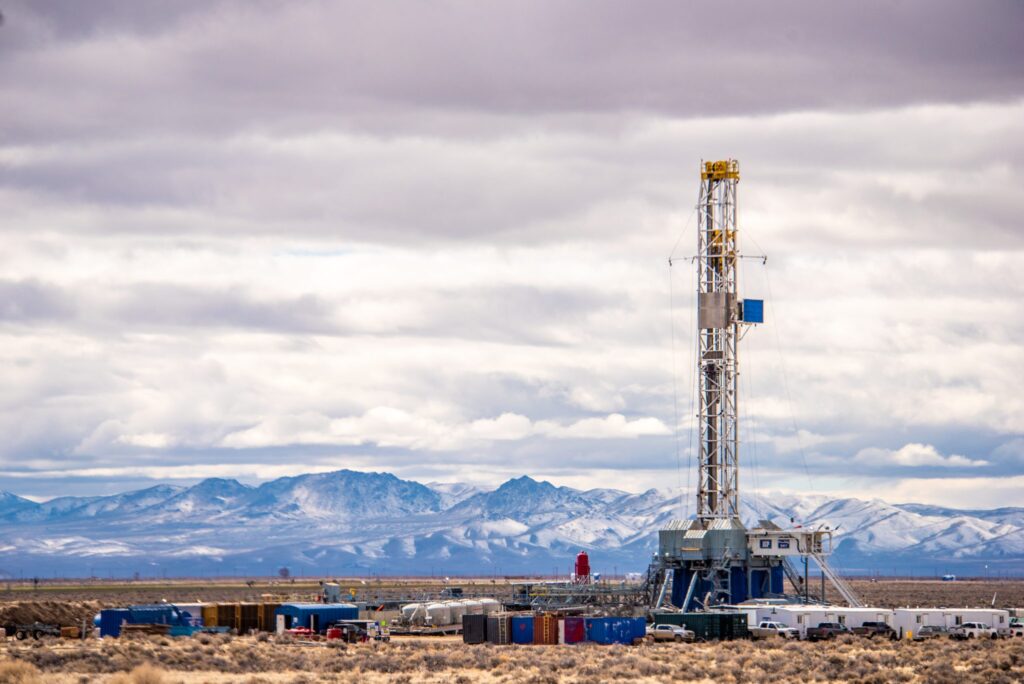 Drilling rig at the site of Project Red, Nevada (source: Fervo Energy)


 Carlo Cariaga
14 Apr 2026
Carlo Cariaga
14 Apr 2026
After more than 600 days of operations, Fervo Energy's Project Red in Nevada provides valuable insights towards optimizing enhanced geothermal systems.
A recent article posted by Fervo Energy presents the operational parameters over the course of 614 operational days of the Project Red geothermal project in Nevada. The results highlight the long-term stability of the operations based on power output and production temperatures, while providing some interesting insights on thermal recovery and recapture of injection fluids.
Project Red, which became operational in 2023, stands out as the longest-running enhanced geothermal system (EGS). Thus, the operational data offers immense value in validating the long-term operational performance of EGS. The wells for Project Red were drilled in the Blue Mountain geothermal field, allowing them to be integrated into existing power generation operations. This is particularly important as Fervo scales up the deployment of EGS technology in its Cape Station project in Utah.
Output is stable, albeit modest
Fervo states an important caveat about Project Red – it was designed as a platform to learn about the long-term performance of EGS. Thus, the wells were not designed to be production-optimized. They were drilled with tighter spacing and with shorter laterals to accelerate data collection and model calibration.
It is also important to note that there were several extended outage periods during the data collection period, although these were attributable to surface facility and grid issues and not due to EGS performance. This only means that the 614 days of operations were not continuous. Outside of these events, the Project Red system operated with a 98.4% uptime.
This defocusing on optimization certainly shows up in the results. In 2023, Fervo released a white paper stating that the EGS well doublet can support 3.5 MW of electricity production (assuming a supercritical ORC cycle) with a flowrate of 63 L/s at high temperature. The parameters under steady-state conditions are a bit more modest, but nevertheless exhibit notable stability.
Over the full operating period, the system delivered an average gross power output of 2.1 MW and an average net output of approximately 1.4 MW, with an average production temperature of 347 °F (175 °C) and a circulation rate of roughly 36 kg/s. Power output remained stable and predictable throughout the operations.
Temperature and thermal recovery
Measured flowing temperature data shows over 500 days of constant-temperature production. Production temperature was maintained at 175 °C with an injection temperature of about 75 °C. There had been a recent slight temperature decline of about 2.5 °F (~1.4 °C), consistent with the onset of thermal decline predicted by reservoir models.
Moreover, recapture rates of around 70% were observed during steady-state operations. These values fluctuated heavily during the observation period. This behavior was interpreted as indicative of temporary storage of fluids within the formation, providing pressure support. The recapture rate is relatively low, but the expectation is that it will improve as the circulation continues and the reservoir becomes more pressurized.
Long-term production data shows that the system has attained a thermal recovery factor of approximately 20% based on initial heat in place calculations within the stimulated reservoir volume. This is already above the benchmarks set by the US Department of Energy and USGS. This figure is expected to still grow as production continues.
Lessons for commercial deployment
The output figures of Project Red are not meant to be representative of what Fervo expects from commercial-scale EGS projects. However, learnings from Project Red will prove to be instrumental in optimizing future EGS deployment. There are already clear pathways to improvement – higher reservoir temperatures, longer laterals, optimized well spacing, and increased fracture connectivity.
The next generation of Fervo’s EGS projects, including Cape Station, incorporates significant design improvements informed directly by Project Red data. As summarized in the table below, moving from the EGS 1.0 design of Project Red to the EGS 3.0 design will improve well output from 2 MW to about 16 MW per well.
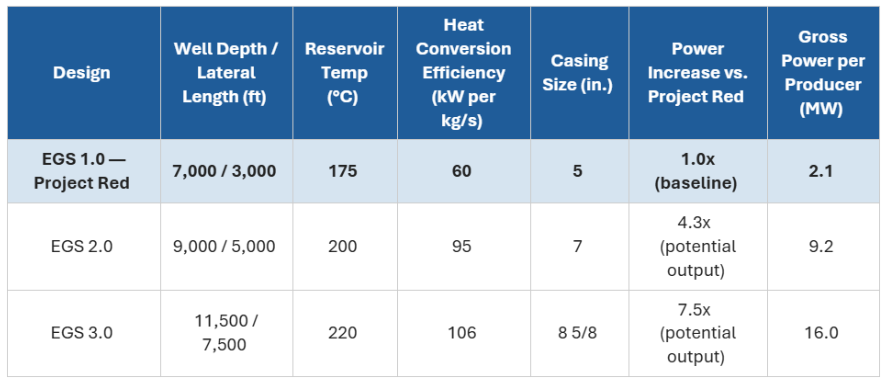
An important takeaway from this presentation is that the reservoir behavior and model calibration matter more than the absolute output numbers. The validation of models will be vital for future design iterations, which may be demonstrated under real-world conditions soon enough at the Cape Station site in Utah.
Source: Fervo Energy